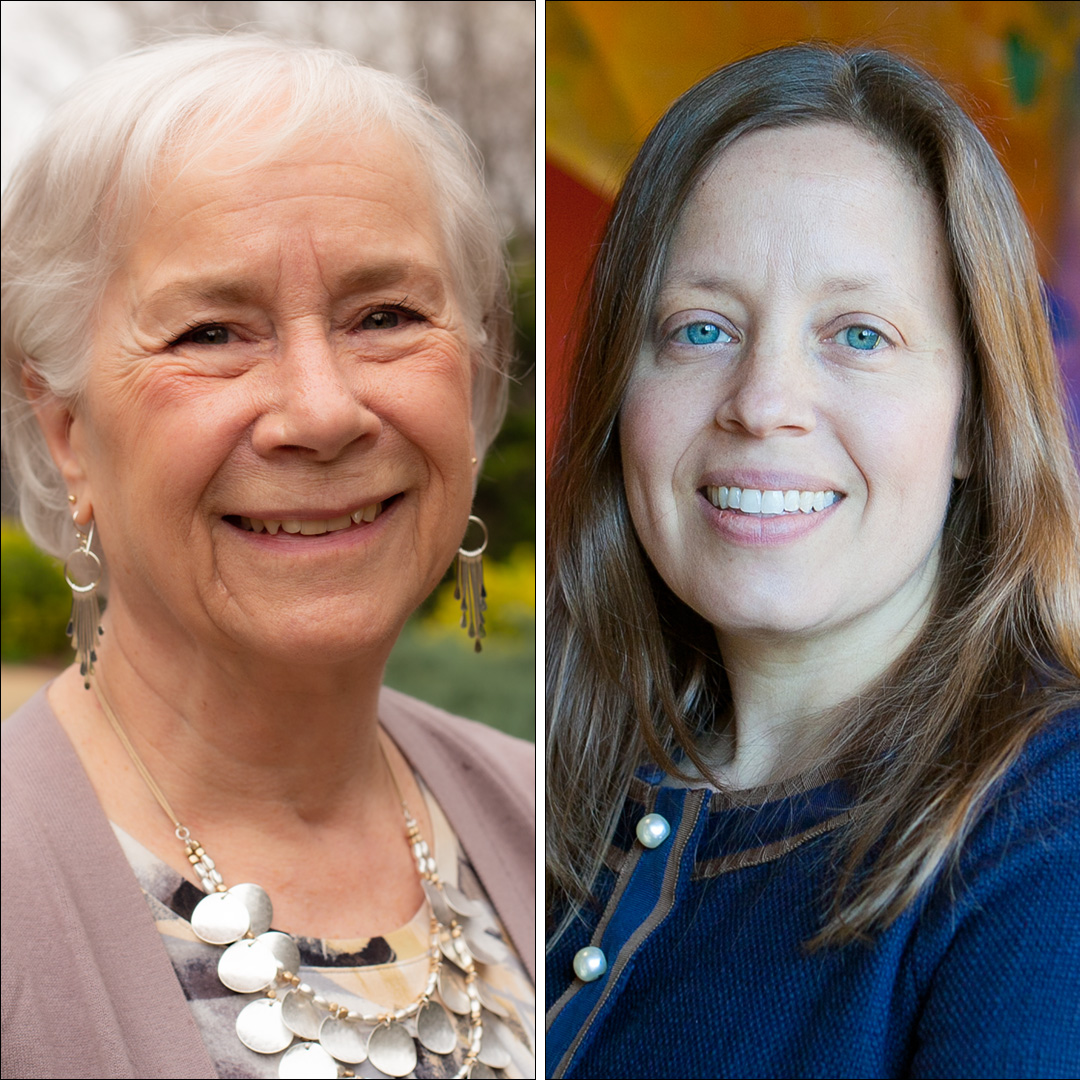
The Women’s History Month theme this year is “celebrating women who tell our stories.” We interviewed Food & Friends founder, the Rev. Carla Gorrell, and Executive Director Carrie Stoltzfus about the history of Food & Friends, and asked them to tell us a story about a woman who inspired them to lean into their full potential.
The Rev. Carla Gorrell, Founder
Tell us the story behind the founding of Food & Friends.
It started in 1988 with a vision at the Westminster Presbyterian Church. The church was one of the first congregations in the Presbyterian polity who ordained gay and lesbian people. We ordained them because it was the right thing to do, and it wasn’t until 20 years later that they changed the polity to make it officially permissible. But our congregation was very diverse and inclusive.
At the time, the AIDS epidemic was still in its early years, and it was rampant in Washington, D.C. The leaders of Westminster attended a conference in New York City at another Presbyterian congregation, West Park, where God’s Love We Deliver had started, to learn more about their home-delivered meal program for people living with HIV/AIDS.
The congregation at Westminster Presbyterian Church had this nice church kitchen down in the basement, but no one ever went down there. They decided they would donate the kitchen as a place where we could prepare meals for persons living with AIDS. I had been looking for a call to get ordained, and I said I wanted to help. We took the Amtrak train and made several visits to God’s Love We Deliver to learn how they were doing it.
Over time, we learned that they were already heavily funded by the city of New York, which was supportive of services for the gay community, and people living with AIDS. We asked the D.C. government to do the same type of funding for us, but they initially said no.
My mentor was the Rev. Dr. Jeanne MacKenzie, who was the pastor of Westminster at the time. It was a small neighborhood church, very much into social justice, community outreach, and it was creative in terms of community building and programs.
It took two years for us to get funding for our home-delivered meal service from the D.C. government. They told us that once we had a track record, they would consider funding us. So, we raised money from individuals. It was mainly people from the gay community and friends and family members of people living with AIDS that helped us get the word out. The word spread fast. People receiving the meals would tell people about it. The need was great. We also provided testimony for the D.C. Council on the epidemic and the needs of the people. Eventually, we received some funding from the D.C. Department of Health and Human Services.
But everyone understood it, because if you have ever been sick, like from a surgery or flu, and you were unable to shop or cook for yourself, you could relate. But people with HIV/AIDS were really suffering. Some of them would die from the lack of food because they lived alone. We got our clients from social workers, and from the Whitman Walker Clinic, and through word of mouth. I remember when we got our first client. We recruited local restaurants to provide the meals. We couldn’t afford to have staff or stock the kitchen, but we had volunteers.
What was the environment like at Food & Friends in the early days?
We were in the basement. In the corner, there was a little table with a telephone and a folding chair. That was my office. I would make calls to all the restaurants and go around picking up the meals. We started delivering in Dupont Circle, and I initially got five restaurants to provide lunches one day a week, and we found five volunteers to deliver each day that week.
We spoke with volunteer Bill Wooge, who remembers packing his own bags in those days, is that right?
My gosh, yes, it was rustic in those days compared to the operation today with all the strict protocols. We did have health department inspections even back then. But after we got the Dupont Circle route started, we expanded to Capitol Hill, which was another area with a lot of people who really needed us.
We added more restaurants, and it took us about nine months to get enough money to hire a real chef and open the kitchen. I was still working at CBS TV as a makeup artist part-time to support myself. I didn’t take a salary at Food & Friends at the time. I was a freelancer, so I could take other jobs.
Do you remember who the first restaurants were that supported Food & Friends?
Yes! It was Annie’s Paramount Steakhouse in Adams Morgan, which is a wonderful gay restaurant. It was a welcoming environment where people were accepted. On Capitol Hill, it was Café Berlin, which was one of my favorites.
Café Berlin would wrap up the hot entrée in foil in the shape of a swan. The clients loved it. They would make these beautiful sandwiches and sides. The clients loved all the fun little details. The food was good.
Who was the first client?
He was a young man referred by Whitman Walker, his name was Frank. He was from Fredericksburg, Virginia originally, and he had some friends who lived in the Dupont Circle area, so he was staying with them. He came because he could not get any medical care where he was from. No doctor would see him.
He was living in a little town house owned by his friends, and I would bring him food nearly every day. I got to know him well and spent a lot of time with him. He only lived a few weeks. Back then, the average time on service was six weeks.
In D.C. at the time, there was one doctor who would see patients with AIDS, eventually there were two. Everyone who was sick with AIDS got very sick because no one fully understood it. There was no treatment at all.
Can you tell us more about what the environment was like?
People died so quickly that we felt a little bit like the MASH unit from the television show. We were dealing with constant loss, and grief, and drama, yet every one of us dealt with it. Sometimes we would use wacky humor to keep going.
But you know, it was satisfying to know that we could do something instead of standing by without helping. You see, when the AIDS epidemic began, nobody could think of anything to do to fix it, but we were proud to be doing something.
Can you tell us more about the first client, Frank?
He was a member of the leather community, and a young man. As he was dying his mother came to visit him in the hospital and my visit happened to coincide with hers. I waited outside his room so they could have some time together, because I knew he did not have much longer.
His mother was telling him he was going to hell, that God hates him, and what he did was terrible. She was spewing fire and brimstone, and it was sickening. After she left, I went in and talked to him and I said no, you are loved.
You were loved before you were born, you were loved every minute of your life, and you will be loved by God in eternity after you die. There were times when you could really make a difference in people’s lives.
What motivated you to follow this path in your life? What prepared you?
The summer before I began, I read the book, And the Band Played On: Politics, People, and the AIDS Epidemic by Randy Shilts. That book inspired me to do something. Also, when my youngest sister was twenty-four, she died of an auto-immune disorder. This was the 1970s and the only treatment we could give her at the time was for pain. She was in and out of the hospital, and when she would come home, she would go through withdrawal and would sit in the bathtub knitting to get through it.
I was very involved in my family’s care of her. So that kind of helped me prepare to deal with people living with HIV. They were young, and they had no immunity, and there was not a lot of treatment available for them. My mother always inspired me, she was one of the biggest supports in my life, but even she asked me why I was doing this.
When I was in college at George Mason University I majored in social psychology and for my field work, I did a year with a hospital in Northern Virginia. One of the doctors didn’t drive, so I drove her around to all the patients who were dying, and I chose to do that because of my experience with my sister. Then when I was in the seminary, I did my field work at Washington Hospital Center for a year in the MedStar shock trauma unit. I was well acquainted with grief and medical settings.
When I visited the first clients the medical community was saying that AIDS was only contagious through bodily fluids. But in the hospitals, they were still putting on hazmat suits. I was a little nervous at first, but that didn’t last beyond the first two visits.
Who inspired you on your journey as a leader? The theme of Women’s History Month this year is “celebrating women who tell our stories.” Who inspired you to lean into your potential and become the woman you became?
I would have to say it was the Rev. Dr. Jeanne MacKenzie. I grew up in the national Presbyterian church and it was a big, fancy, rich church. When my marriage fell apart while I was in seminary, the pastor asked me if I would like to help a little church in southeast called Westminster.
As soon as I went there, I met Jeanne, and she was the first person who let me run with things. Jeanne was a member of the first-ordained group of women in our presbytery, in our jurisdiction, and she invited me to join the group.
We were feminists, we had to be. We met for lunch every week together and there were some Episcopal women who were also irregularly ordained, we were all among the first women to be ordained in our churches. We called ourselves the burp group because we would make rude noises. We had our own insular humor.
We would meet for professional, personal, and spiritual support. This was in the seventies. We are still meeting for lunch every week, once a week, and it has been going on for 40 years now. During COVID we were able to meet on Zoom.
Jeanne was a real pioneer. She was among the first group who really dealt with a lot of push-back as a woman pastor from the church establishment. It wasn’t as bad for me as it was for them, but had they not done what they did, I wouldn’t have been in the position to start Food & Friends.
What are three things that stood out as turning points in the history of Food & Friends?
I could think of so many more than three, so I will give you the first three that pop into my head. There was a man named Mike Morris, who served as Deputy Director with me. He had moved to southwest, and he showed up to wash dishes in the kitchen at Food & Friends. He was a businessman, and he was diagnosed with HIV, and had given up working because he was ill. He asked me, “Carla what’s your business plan?” and I did not have one at the time, so he said, “well I will help you get one.”
That was a big turning point. He put together a plan, and an organizational chart and helped me identify the positions we needed. At the time, when we first started, I was doing all of it. He helped me understand the people we needed to attract and what experts to look for. It led us to hiring the fantastic Brent Minor, who was our first volunteer director. This was very similar to what Jeanne did for me. It was Mike Morris who gave me the business plan, and he let me run with it.
I loved Mike like a brother. I never had a brother of my own. When he died in 1992, I think my grief and loss from losing my sister, and all the funerals I did as a minister caught up with me. Mike was one of my best friends.
The second moment that stood out has to do with our expansion to Anacostia. We reached a block, because a social worker was reaching out to us about clients in Anacostia who needed meals. We tried to recruit volunteers to go over there but were having a hard time finding people. One day, a man showed up at Food & Friends. It turns out he was Bob Medford, and he was a vice-president at a new communications company starting up called Comcast. It turns out that both he and his partner had tested positive for HIV and his partner was quite ill.
His partners kidneys had failed, and he was on dialysis. Bob and his partner lived in Anacostia and Bob agreed to do the deliveries. That was a total breakthrough. Bob built us a team of volunteers, and we began to serve a whole new population. It opened Food & Friends to the Black community in a breakthrough way. It was like a miracle that he showed up. I did a holy union for Bob and his partner, and it was an amazing moment.
The third standout moment for me was the Ryan White grant availability. That really helped us take off in a big way because it was reliable. It took a lot of time to get the grants and keep them going, but it improved everything. But we also had many individual donors who were very committed. They kept on giving and caring. Individual gifts were the highest percentage of our income and a healthy way for us to keep going.
It was also pivotal when the AZT drug treatments came out to treat HIV/AIDS. I remember, we used to have an annual volunteer banquet, at conference center, and Brent Minor did this beautiful toast. He would say, “here’s to the end of it, and the last meal will be surf and turf!” It meant that one day we would go out of business because there would be a cure for HIV. We heard it every year.
When the organization got a new building, and expanded to serve individuals with other illnesses, it was such a milestone. I was always very supportive of the success of Craig Shniderman, who served as the Executive Director after I left. I was also very excited when Carrie Stoltzfus became the Executive Director. She has been so wonderful to include me in many things.
Carrie Stoltzfus, MPH, Executive Director
Tell us a story about your early experiences at Food & Friends, what is something we may not know?
The things we serve have become so much healthier. We had a very different approach to nutrition when I first joined as a staff member 20 years ago. Particularly for people with AIDS, we were primarily serving a high-calorie diet because the medication available was nowhere near as effective.
It has been especially exciting to be a part of the evolution of the organization and see us become leaders in nutrition. When I first started, it was mainly about making sure people had enough calories. There were even hamburger days.
What was the atmosphere like? Who were the volunteers?
I remember the early days I was working with Bill Wooge, Ralph, and Lea Emerson, and they are still volunteering to this day! They were some of the first people I met in the city when I moved here, and I am still in touch with them through Food & Friends. They are like family. I started working at Food & Friends within three months of arriving in the city.
I lived in Brightwood, and I had five or six roommates in the house, there was no air conditioning. I drove all the way to work in Southeast every day. We were in Navy Yard at the time, and it took a while. I started in 2003 and we moved to our current headquarters in 2004.
Back then it was very different, we just had a few delivery vans. We had no admin vehicles. We had a tiny parking lot. We were home-delivering to all of D.C. by then, but we only did groceries to certain parts of Prince George’s County, Montgomery County, and Northern Virginia.
There was such a bond on our Saturday team between the staff and the volunteers. There was one volunteer coordinator and one client services person who worked on Saturday. Craig started in 1995 and I started in 2003 as a staff person, so we had really begun to evolve as an organization by that time.
Who inspired you on your journey as a leader? The theme of Women’s History Month this year is “celebrating women who tell our stories.” Who inspired you to lean into your potential and become the woman you became?
There was a boss I had here at Food & Friends, C. Marie Taylor. She was the first supervisor I ever really bonded with. She took me under her wing and taught me how to be a leader and how to be a professional. She was very open in conveying those lessons. I first worked with her in the client services department, and then she became the program director. When she got promoted, I took over for her as the client services manager.
She had been teaching me so much, and I was able to follow in her footsteps and run the department. She is great. I remember her, and Craig Shniderman, telling me they believed I could do it. It was my first real leadership opportunity. I had led projects before but had not supervised other people.
She was intentional about teaching, and that is the best thing you can hope for as a young person. She was always open about how she led, she talked about it. She was great. We bonded and our personalities were complimentary of each other. She was my supervisor for eight years. We accomplished a lot.
Can you share your top three most pivotal moments in the history of Food & Friends?
In 2013, when we expanded to serve individuals living with diabetes, we did a pilot project. We had not expanded to another illness since cancer, which we did in 2000. We studied diabetes, and we began sending medically tailored meals to people, and looking at how they were doing health-wise. We used that in our decision making and decided to expand. It really set the stage for future growth. There had been a long gap without an expansion. It helped us understand that we could adapt our work to help more people.
Moving the current building also made a big difference, because it allowed us to have a place where we could grow intentionally and have the room we needed. It gave us enough space to respond to the community’s needs. It gave us the room to operate in new ways.
Another pivotal moment was when we began to work with insurance providers, and how well we have been able to show them the benefits of what we do. We can now rely on research that demonstrates the positive impact of our service. It positioned us differently because it showed that we are not only a social service, but also a clinical service.
We have always known we were doing the right thing, and we knew that food is medicine. But when the research came out that showed the impact of medically tailored meals on people’s health, and how it lowers health care costs we started to see how it could change the way people saw our work. It helped us show the greater value.
We are compassionate, we provide foods that heal, but we also have a positive impact on overall community health and an important economic impact. We can now show that we are not only good for the person, but also good for broad systems.
So being a part of the Food Is Medicine Coalition has helped us do our work on a broader scale and be more sophisticated in the way we collaborate and strategize. It has made a big difference.
So much has changed about Food & Friends, but what has stayed the same?
What has never changed are the conversations that happen on people’s porches, and at people’s doors when we deliver the meals. I love the fact that we are meeting people where they are. No one must come here and wait in a line. We are like a friendly guest at their home, or a caring neighbor. I think that is important, that is the “friends” part in our name.
One thing that has never changed is the commitment of the staff and volunteers. It has always been strong throughout my entire time at Food & Friends. This place has always been run by people who can see themselves in the neighbors we serve. They know a life-challenging illness can happen to anyone. Many of us have seen it happen to our loved ones. The dedication of taking care of the people we are committed to serving has always been a constant.
To further explore this history of Food & Friends please click here: https://foodandfriends.org/#history