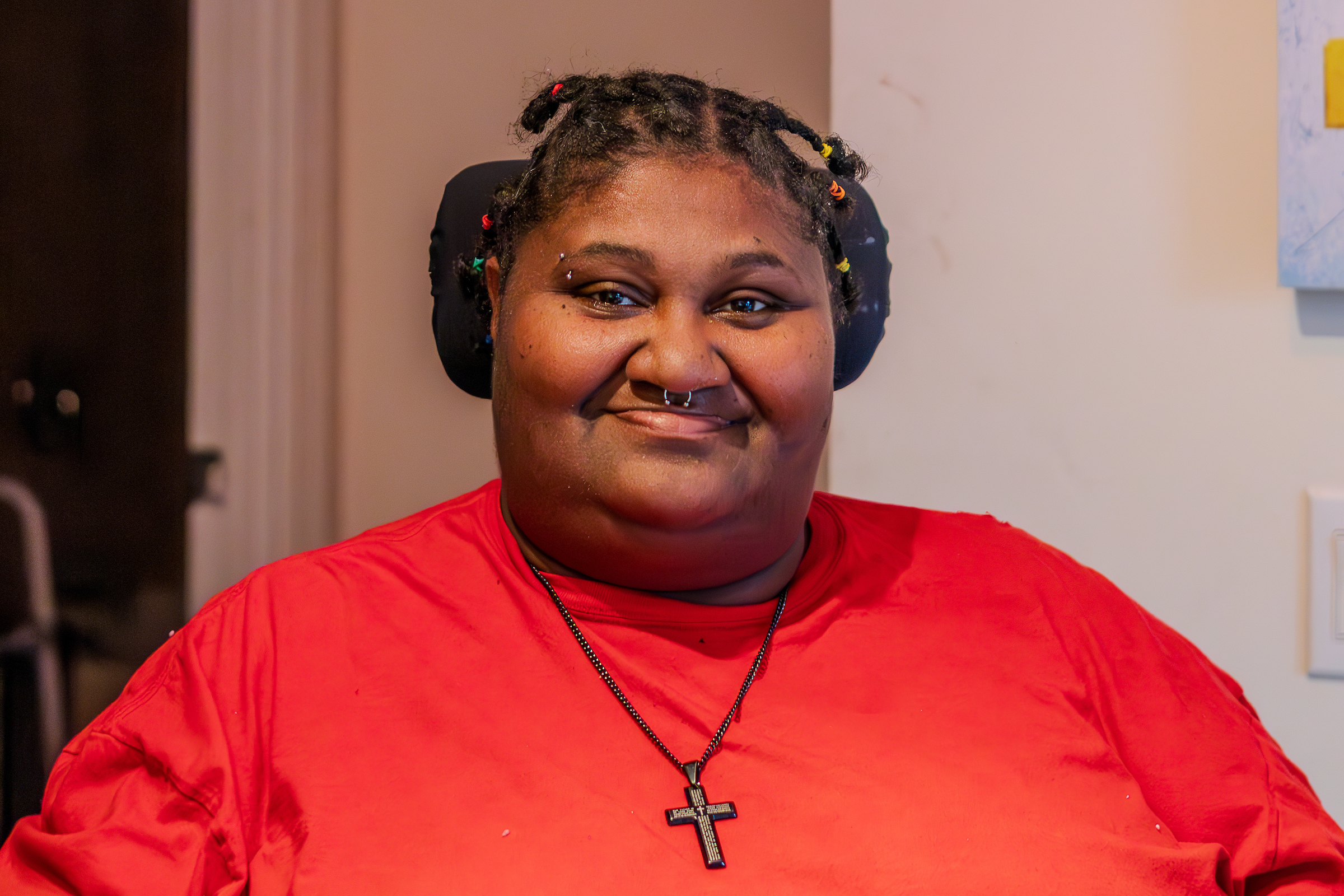
Connie’s life never followed a straight line. As a child in the foster system, her early years were spent shuffling between Maryland, D.C., and Virginia. She never stayed in one place for too long. “I grew up pretty much everywhere,” explains Connie. Despite the instability around her, Connie wanted to help people. As a teenager, she entered Job Corps, earning her GED and graduating as a Certified Nursing Assistant.
Connie lived with her grandmother in an independent living facility, before moving into her first shelter at 19 where she met the love of her life. Within a few short years, her partner was murdered. The loss shattered Connie, and she began using drugs and wound up living on the streets.
Diagnosed with HIV following a sexual assault, she began to turn over a new leaf. Newly sober at age 28, Connie found her first apartment, but navigating the available social services was challenging.
Her HIV symptoms were worsening, and daily tasks became impossible. “My sickness was taking over me more day by day. I really needed someone to help me prepare meals.” After her case manager suggested Food & Friends, she began receiving our home-delivered medically tailored which was a game changer for Connie. “I was depending on a lot of help from a lot of people that I really didn’t even know. So once [Food & Friends] started coming with the prepared meals for me, I was able to become a little bit more independent!”
Connie also took advantage of the cooking classes and nutrition education offered by Food & Friends. As a longtime fan of Gordon Ramsey, she readily stepped into the commercial kitchen at Food & Friends to learn some new culinary skills. Connie got a job working with the Washington Nationals, became a cook at the stadium, and was able to transition from receiving meals.
After COVID closed Nationals Park to the public in the spring of 2020, Connie began cooking at Children’s National Hospital where she combined her lifelong passion for medicine and her desire to help people. “I did food delivery sometimes because I would be able to go upstairs to the rooms and I would be able to see the patients.” She would “wear colorful socks or cartoon socks just to make the kids smile”.
New health challenges emerged. Osteoarthritis and a possible bone fusion limited her mobility and forced Connie to stop working. “You go from nursing to cooking, to being in a wheelchair and can’t seem to find a job, which is driving me crazy because I’m not the type that wants to be sitting in the house.”
As she adapted to life in her wheelchair, Connie returned to Food & Friends medically tailored meal program, which addressed a growing gap in her social safety net. “Here I am: heart disease, HIV positive, wheelchair, winter time, snow on the ground, trying to make it to a food bank because I get $30 in food stamps a month. If I didn’t have Food & Friends, I wouldn’t—I’m not going to be able to eat.”
The deliveries from Food & Friends have meant more than just a meal to Connie – they’ve been a lifeline of emotional support during difficult times. “When you’re by yourself, it seems it just seems like nobody cares. The best part is getting a birthday cake from Food & Friends. Just being able to get like a cake somebody baked me. Somebody cared or somebody’s child cared enough to write me a little letter and just make me something special.”
Today, Connie sees Food & Friends as a reminder that no one is immune from sickness or disability. “I went from being a person sleeping on the concrete to working three jobs, to being in a wheelchair, and not being able to be able to put food on my own table. So just because you had it all, don’t mean that you can’t fall into a position where you need this type of help yourself.”
Despite her setbacks, Connie continues to give back to those around her. She is an advocate for neighbors living with HIV/AIDS, since so many people are afraid to speak up “They’re afraid to go to the doctor. I’m letting people know things are not really as bad as it seems.” She also shares her story of addiction, saying: “If I can help anybody to get out of the struggles because I remember being that same drug addict. So now it’s time for me to help pick someone else up.”
Even confined to her wheelchair, Connie is determined to give back whatever she can. “So now that I don’t wear my shoes as much [because of the wheelchair], I’m donating my shoes to the homeless, donating clothes, old coats, stuff like that.”
And she has put into action something she’s known all along: kindness is never wasted. “If you can help just one person—like they say—you help one person, but to that one person, it’s like the world.”